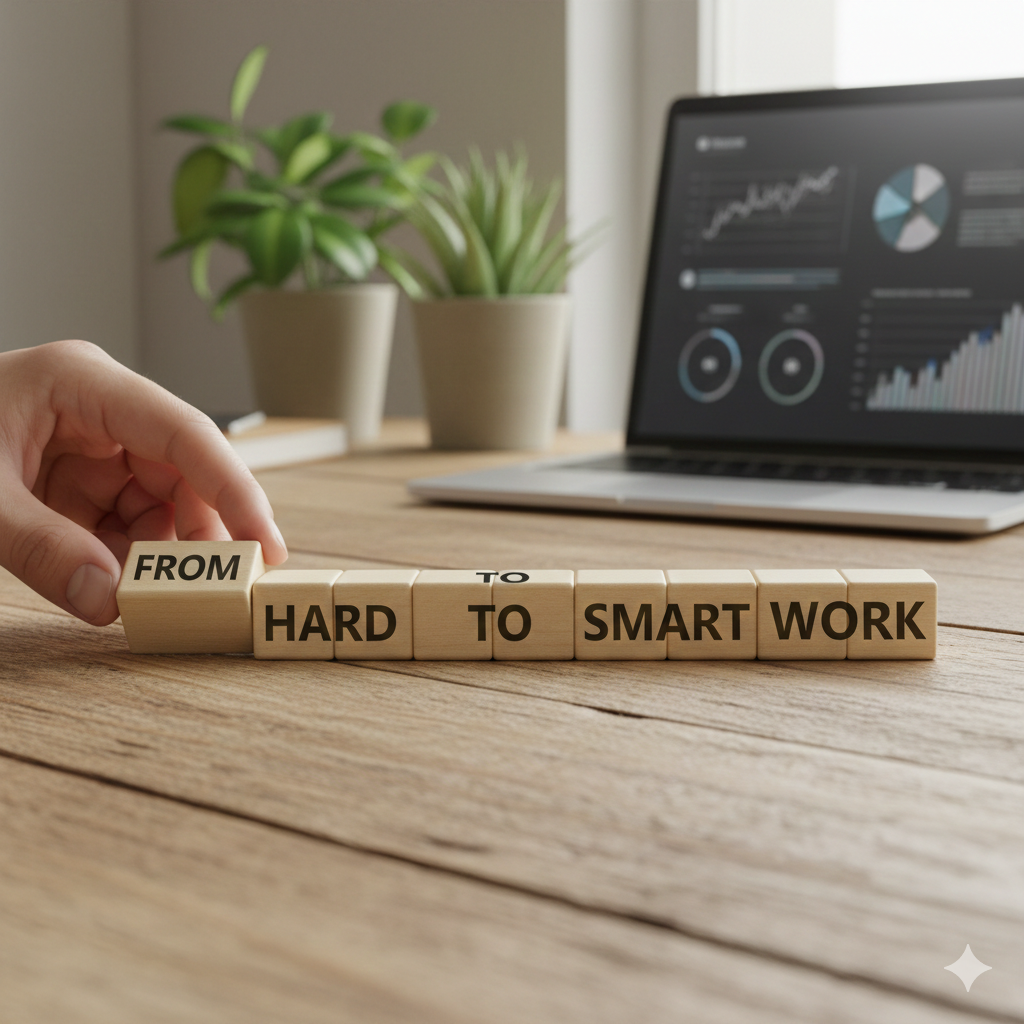
Hard Work vs Smart Work: The AI Revolution in Your Daily Life
How to Work Efficiently Without Burning Out?
Remember the last time you stayed late at the office, grinding through tasks, only to realize someone else finished the same work in half the time? That frustrating moment perfectly captures the difference between hard work and smart work. And now, with artificial intelligence entering our workplaces, this difference has become even more dramatic.
Here's the thing: AI can analyze data in seconds that would take a human hours or even days. It's not here to replace us, but it's definitely changing the rules of the game. Let's explore how you can use both hard work and smart work powered by AI to achieve more while stressing less.
What Does Hard Work Really Mean?
Hard work is the traditional way most of us were taught to achieve success. It's about dedication, perseverance, and putting in the hours. Think of it as the "blood, sweat, and tears" approach.
Real world example: Imagine you're preparing a 50-page report. The hard work approach means manually typing every section, double checking each figure, formatting every page by hand, and reviewing it multiple times. You might spend 20 hours on this task, working late nights and weekends.
Hard work builds character and discipline. It teaches you resilience. But here's the catch if you're only working hard without strategy, you risk exhaustion, decreased productivity, and even health problems. That's where smart work comes in.
What Makes Smart Work Different?
Smart work is about achieving your goals efficiently. Instead of just working harder, you work strategically by using the right tools, methods, and shortcuts that don't compromise quality.
Using the same example: For that 50 page report, smart work means using templates, automation tools to gather data, AI assistants to draft sections, and formatting software to make everything look professional. You might finish the same quality report in just 6-8 hours.
According to recent surveys, about 65% of professionals are now using AI tools in their work, and they report saving an average of 5-10 hours per week. That's more than a full workday saved every week!
The beauty of smart work is that it frees up your time and energy for tasks that truly need your human creativity, judgment, and expertise.
Hard Work vs Smart Work: Key Differences
Approach: Hard work relies on manual effort, long hours, and repetitive tasks. Smart work leverages strategic planning, automation, and efficient tools.
Time Investment: Hard work continues until the task is done, no matter how long it takes. Smart work is optimized to work smarter, not longer.
Energy Level: Hard work often leads to burnout and fatigue. Smart work is sustainable and helps maintain work-life balance.
Focus Area: Hard work focuses on completing tasks through sheer effort. Smart work focuses on achieving results through efficiency.
Example: Hard work would mean typing 100 emails individually by hand. Smart work would use email templates and AI to personalize bulk emails in minutes.
How AI is Transforming the Way We Work?
Artificial intelligence isn't just another tech buzzword, it's fundamentally changing how we approach work. Here are four powerful ways AI makes smart work even smarter:
1. Eliminating Repetitive Tasks
Nobody enjoys doing the same boring task over and over. AI excels at automation, taking care of mundane work so you can focus on what matters.
Example: Sarah, a marketing manager, used to spend 3 hours daily responding to customer inquiries. After implementing an AI chatbot, it handles 80% of common questions instantly. Now Sarah spends those 3 hours developing creative campaigns instead of work that actually requires human creativity.
2. Enhancing Your Creative Abilities
AI doesn't replace human creativity, it amplifies it. Think of AI as your creative partner who never gets tired and always has fresh ideas.
Example: David, a content writer, uses AI to brainstorm article topics, create outlines, and even draft initial versions. But he adds his unique voice, personal experiences, and expertise to make the content truly valuable. The result? He produces 3 times more content without sacrificing quality.
3. Making Faster, Better Decisions
In business, making the right decision quickly can mean the difference between success and failure. AI processes massive amounts of data in seconds, revealing patterns humans might miss.
Example: A retail company used AI to analyze customer purchase patterns. The system predicted that winter coats would sell 40% more than usual due to weather forecasts. They stocked up early and sold out completely, while competitors ran out of inventory or overstocked the wrong items.
4. Supporting Remote and Flexible Work
Working from home or different time zones used to be challenging. AI-powered tools now make remote collaboration feel seamless.
Example: A global team across 5 time zones uses AI scheduling assistants to find meeting times that work for everyone, AI transcription tools to record and summarize meetings for those who can't attend, and automated project management systems that keep everyone updated in real-time.
5. Finding Your Perfect Balance
Here's the truth: you need both hard work and smart work. Hard work builds your foundation, your skills, discipline, and resilience. Smart work, especially with AI, helps you multiply the results of that hard work.
6. Think of it this way
Hard work alone is like rowing a boat with all your strength you'll move forward, but you'll exhaust yourself. Smart work with AI is like adding a motor to your boat you still need to steer and navigate, but you'll move much faster and farther with the same effort.
5 Practical Tips to Work Smarter with AI Today
Tip 1: Identify Your Repetitive Tasks
Write down everything you do regularly that feels mechanical or boring. These are prime candidates for AI automation. Examples include data entry, scheduling, email sorting, or basic customer responses.
Tip 2: Start Small
Don't try to automate everything at once. Pick one task, find an AI tool that helps, and master it before moving on. For instance, start with an email assistant before tackling complex project management.
Tip 3: Use AI for First Drafts
Whether it's writing reports, creating presentations, or designing graphics, use AI to create the initial version. Then apply your expertise to refine and personalize it. This approach saves hours of staring at blank pages.
Tip 4: Combine AI with Human Skills
Remember that AI handles data and patterns brilliantly, but you bring empathy, ethics, creativity, and context. For example, let AI analyze customer feedback data, but you decide how to personally respond to unhappy customers.
Tip 5: Invest Time in Learning
Yes, this requires some initial hard work! Spend time learning how to use AI tools effectively. Watch tutorials, experiment, and practice. This upfront investment will pay dividends for years to come.
The Ultimate Goal: Work Life Harmony
Work life balance isn't about splitting your time 50-50 between work and personal life. It's about having enough energy, time, and mental space for both. It means finishing your work efficiently so you can enjoy dinner with family without checking emails. It means having weekends that actually feel like weekends.
AI makes this possible by handling time consuming tasks, reducing stress from tight deadlines, and giving you back hours in your day. Recent studies show that workers who effectively use AI tools report 30% less stress and significantly better work satisfaction.
Real story: Maria, a single mother and accountant, was working 12-hour days during tax season, rarely seeing her kids. After adopting AI accounting software that automated data entry and basic calculations, she cut her hours to 8 per day while maintaining the same quality. She now has evenings free for homework help and bedtime stories.
Final Thoughts: Work Smarter, Live Better
The debate between hard work and smart work isn't about choosing one over the other. It's about understanding when to apply each approach. Hard work builds character and skills. Smart work, amplified by AI, multiplies your impact.
The professionals who thrive in the coming years won't be those who resist AI or those who blindly depend on it. They'll be the ones who thoughtfully combine their human strengths, creativity, empathy, strategic thinking, and ethical judgment with AI's strengths in speed, data processing, and automation.
So ask yourself: Are you still rowing your boat with pure muscle power, or are you ready to add a motor while keeping your hands on the wheel?
The choice is yours. The tools are ready. Your smarter, more balanced work life starts today.